info@cadetpro.com
English flag
English
Select a Language
English flag
English
Arabic flag
Arabic
Spanish flag
Spanish
0
DIAGRAMMATIC REASONING / REAL MODULE DEMO Ready Open in a new tab
How it works

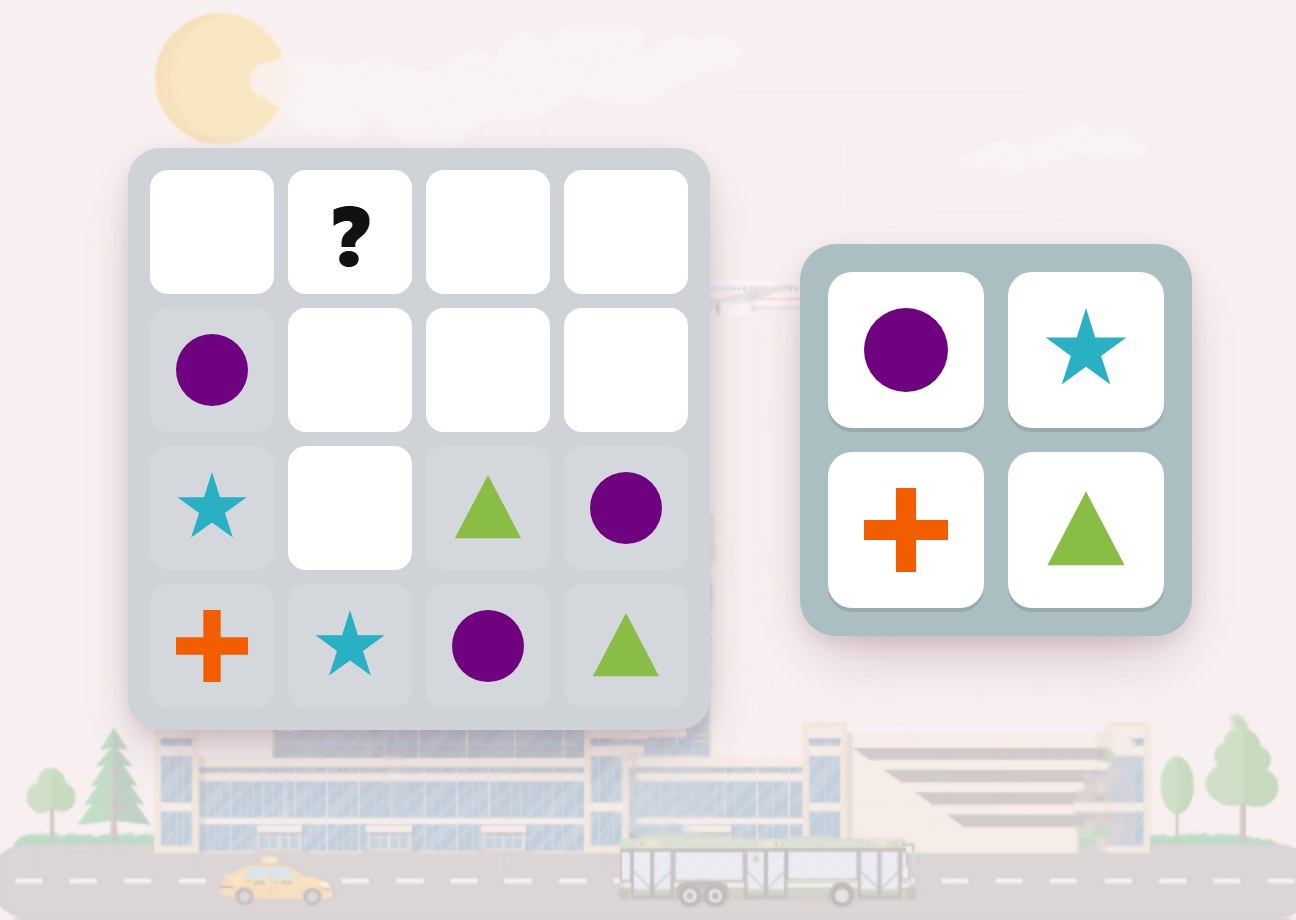
Every question shows a matrix with one cell missing. An unwritten rule runs along the rows or the columns — a rotation, a count, a mirror, a set operation — and your job is to work it out and pick the figure that belongs in the gap, from four options labelled A to D. Ten questions in twenty minutes, free navigation with flagging, and no penalty for a wrong answer.

Loading the real module
Module logic

Eight families.
One missing cell.

The prompt above every question reads Which box is next in sequence? — but the structure is a matrix, and the rule runs along the rows or the columns rather than left to right in one line. Reading the grid instead of the sentence is the first thing to fix. Eight families produce every question you will meet, about a third of questions carry two of them at once, and the four wrong options are each a named mistake. The five steps below are the order in which they are worth learning.

Overall accuracy
80.0%
STEP 01

A matrix with a hole, and four ways to fill it

Every question is a grid of figures with one cell replaced by a question mark, and four options underneath labelled A to D. Exactly one is right. The grid is 3×3 about three quarters of the time; the rest are 2×3 or 3×2, and those two are not the same thing — they change which axis the rule can run along. The gap sits in the bottom-right corner in three questions out of four, but not always: a gap in the middle or the top row lets you read the rule from both sides, which is a gift rather than a difficulty. Cells hold either a figure (about 60%) or a small sub-grid of filled squares (about 40%). In roughly one question in thirty a whole line is missing and each option is a three-cell strip — the same rule, applied three times.

Live module
What it measures

Ten questions.
Two minutes each.

Nothing on the screen is written down: no numbers, no words, no instructions beyond one sentence that is the same every time. What is measured is how fast you can discover an unfamiliar rule from a handful of examples and apply it without slipping — two minutes a question on paper, though the questions are not equally hard. Each question has one right answer out of four, and a wrong answer costs no more than an empty box.

01 / RULE DISCOVERY

The rule is never written down.

A grid of figures and one empty cell — no words, no numbers, nothing to remember. Discovering an unfamiliar rule from a few examples and applying it once is the whole task, which is why the questions are the same in every language.

02 / GRID READING

One axis carries the rule.

The rule runs along the rows or the columns, and the other axis quietly holds a constant of its own. The right option satisfies both; the closest wrong one applies the rule correctly and wears the neighbouring line’s constant.

03 / ANTICIPATION

Build the answer before you look.

Each wrong option is the answer to a specific wrong thought — run backwards, one step too far, the neighbouring line’s constant. Deciding what you expect before reading the options takes most of their power away.

04 / TIME DISCIPLINE

Ninety seconds, flag it, come back.

Twenty minutes over ten questions is two minutes each, but they are not equally hard and one stubborn question can eat three easy ones. Navigation is free and any question can be flagged, so run a first pass, come back to the flags, and end with a sweep that leaves no box empty — a blank scores exactly what a wrong answer does.

Included with PRO

Let every session write your next study plan.

Every Diagrammatic Reasoning session you finish is broken down automatically. See more than the right–wrong ratio: which of the eight families cost you, whether the two-rule questions are where you lose them, whether figures or sub-grids are harder for you, and which wrong thought you keep having.

01

Time per question and pace

Every question’s duration and your median, so you can see where the twenty minutes actually went — and whether one question ate three.

02

The family breakdown

How many questions each of the eight families produced and how many you got right. Rotation and count arithmetic are half the test between them, so a weakness there is worth far more than one in the rare families.

03

Which wrong thought you had

Every wrong option is a named mistake, and the report counts which ones you picked — alongside how often each was even offered. Two “wrong direction” answers out of ten chances is a different problem from two out of two, and only the ratio tells you which you have.

04

Question review, in words

Every question can be reopened afterwards with the correct answer and the rule written out as a sentence — not a code, an explanation. It is free, and it is where the actual learning happens: finish the test, then read the review.

Choose PRO access — unlock your report →Detailed performance analysis is included in every access plan.
VERIFIED REVIEWS

No reviews yet.

This module has just been published. Verified reviews from CADETPRO students appear here automatically as they come in — we do not write them ourselves and we do not display placeholder ratings.

0reviews
average
0negative

CADETPRO course data — real student reviews, read live from the course record. Names shortened for privacy.

Support

Frequently Asked Questions

For anything not covered here, get in touch:

info@cadetpro.com →
What is the diagrammatic reasoning test in the Wizz Air Pilot Academy selection process?

Each question shows a grid of figures with one cell replaced by a question mark, and four options labelled A to D underneath. An unwritten rule runs along the rows or the columns — something rotates, a count changes, a shape is mirrored, two cells combine into a third — and you work it out and pick the figure that belongs in the gap. Exactly one option is correct. Under exam conditions there are ten questions in twenty minutes, with free navigation and flagging.

Why is it also called Raven?

Raven is the classic name for this question type — Raven’s Progressive Matrices — and both names describe the same thing: a matrix, a missing cell and multiple-choice options. The prompt above each question reads "Which box is next in sequence?", which is slightly misleading: the structure is a grid, and the rule runs along a row or a column rather than left to right in a single line. Read the grid, not the sentence.

How is it different from the other Wizz Air logic tests?

CADETPRO ships a module for each of them and they ask for different things. Deductive logical reasoning fills a cell so a grid obeys stated constraints. Inductive logical thinking and inductive logical reasoning classify figures against a hidden rule. Logical thinking asks which one object of nine breaks a rule. Abstract logical reasoning continues a transformation across a row of panels. This one gives you a matrix with a hole and asks what belongs in it.

Is the demo on this page the real module?

Yes. The player and the walkthrough panels load the same module you get after purchase, straight from hub.cadetpro.com. The free EASY and MEDIUM modes are open without buying anything, and EASY writes out the rule in words after every question — which is the fastest way to learn the eight families.

What is the difference between the four modes?

EASY is free: 6 questions, no time limit, and the rule explained in words after each answer. MEDIUM is free too: 10 questions, still untimed, with the review at the end instead. HARD and EXAM are PRO: 10 questions in 20:00 with free navigation and flagging. HARD and EXAM are identical in content — only EXAM counts towards your best score, the leaderboard and badges, so HARD is a full dress rehearsal that cannot spoil your statistics.

How many rules run at the same time?

One or two, never three. About 30% of questions carry two families at once, and an exam session contains exactly three of them — EASY contains one. This is where the test separates people: you find the first rule, spot an option that fits it and mark it, but only one option satisfies both, and the one that satisfies the first and fails the second is there for exactly that reason.

How is the score worked out?

The result screen shows the raw number correct and a performance percentage, and the percentage is not linear. On the ten-question test one and two correct both score 10, while five correct is 41 and eight correct is 77 — the last few questions are worth disproportionately more. Speed does not raise the score, a blank counts as a wrong answer, and any test with a mistake in it is capped at 98.

Is this an official Wizz Air product?

No. CADETPRO is an independent preparation platform and has no affiliation with, endorsement from or partnership with Wizz Air or any assessment provider. The module reproduces the publicly described format of the test so you can practise it; it is not the assessment itself, and no result here guarantees any outcome in a real selection process.

Wizz Air Diagrammatic Reasoning PROWizz Air Diagrammatic Reasoning prep module · 30-day access · 199 TL
BUY NOW
30-day access199 TL
Select plan