Every question puts nine objects in a single row, labelled A to I. Eight of them share a hidden rule and exactly one breaks it — you only have to point at the one that breaks it, never to put the rule into words. The rule sits on a single dimension; everything else on screen is deliberate noise. Ten questions in ten minutes, and you can move between them freely.
Eleven families.
One broken object.
The test never tells you the rule, and you never have to put it into words — you only have to point at the object that breaks it. The catalogue behind the questions is finite: eleven families that can appear, on two archetypes and three tiers, generated from 2,518 rule variants. Preparation is not about being cleverer on the day; it is about recognising an archetype in seconds. The five steps below are the order in which they are worth learning.
Nine objects, and the one that does not belong
Every question shows nine objects in a single row, labelled A to I from left to right; on a narrow screen they wrap into three rows of three, but the reading order never changes. Eight of them follow one hidden rule and exactly one does not. You mark the one that does not — and that is the whole task. You are never asked to name the rule, which is what separates this test from its inductive siblings: there you find a rule and apply it, here you only point at the violation. Click the object or its letter; the keyboard works too, A to I.
Ten questions.
Sixty seconds each.
The test never states the rule and never asks you to name it — it asks you to find the single object that breaks it. What is measured is whether you can separate a real pattern from the noise deliberately layered over it, under a clock that leaves about a minute a question. Each question has one right answer out of nine, and a wrong answer costs no more than an empty box.
Signal, separated from noise.
In every question exactly one dimension carries the rule and all the others are randomised on purpose. Telling the meaningful variation from the deliberate distraction is the whole task; nothing here rewards recall or general knowledge.
Archetype first, pattern second.
Roughly 45% of questions are odd-one-out and 55% are sequences, and the two need opposite reading. Looking for a sequence in an odd-one-out question finds nothing at all — which is why the first ten seconds go to that decision alone.
Count, do not estimate.
Counting families are about a fifth of the exam and the elements are laid out like dice pips: one to three read at a glance, six and seven do not. Most of the loss in this part of the catalogue comes from estimating instead of counting.
No penalty — so never leave a blank.
A wrong answer is scored exactly like an empty one, so an unanswered question is a guaranteed zero where a guess is one chance in nine. Navigation is free and any question can be flagged, which makes the last minute a sweep for blanks rather than a scramble.
Let every session write your next study plan.
Every Logical Thinking session you finish is broken down automatically. See more than the right–wrong ratio: whether you lose questions to odd-one-out or to sequences, how the three difficulty tiers treated you, and whether what you lost was a wrong answer or a box you never filled in.
Time per question and pace
Every question’s duration and your median, so you can see where the ten minutes actually went.
The archetype breakdown
The module’s central diagnosis: your accuracy on odd-one-out questions against your accuracy on sequences. They are different skills and they need opposite practice, so a single overall percentage hides the answer.
Tier breakdown and error classification
How the easy, medium and hard tiers treated you, with wrong answers counted separately from blanks. Losing a question you answered and losing one you never filled in are different problems with different fixes.
Family matrix, flagging and letter bias
Hit rate and time for each family, whether the questions you flagged really were your weak ones, and whether your answers drift toward a favourite letter. Questions you never opened are reported as not measured rather than as zeros — an invented diagnosis is worse than none.
No reviews yet.
This module has just been published. Verified reviews from CADETPRO students appear here automatically as they come in — we do not write them ourselves and we do not display placeholder ratings.
✓CADETPRO course data — real student reviews, read live from the course record. Names shortened for privacy.
What is the logical thinking test in the Wizz Air Pilot Academy selection process?
Each question puts nine objects in a single row, labelled A to I from left to right. Eight of them follow one hidden rule and exactly one does not, and your only job is to mark the one that does not — you are never asked to name the rule. There are ten questions in ten minutes, you can move between them freely and flag any you want to come back to, and a wrong answer is scored the same as an empty one.
How is it different from the inductive logical reasoning and inductive logical thinking tests?
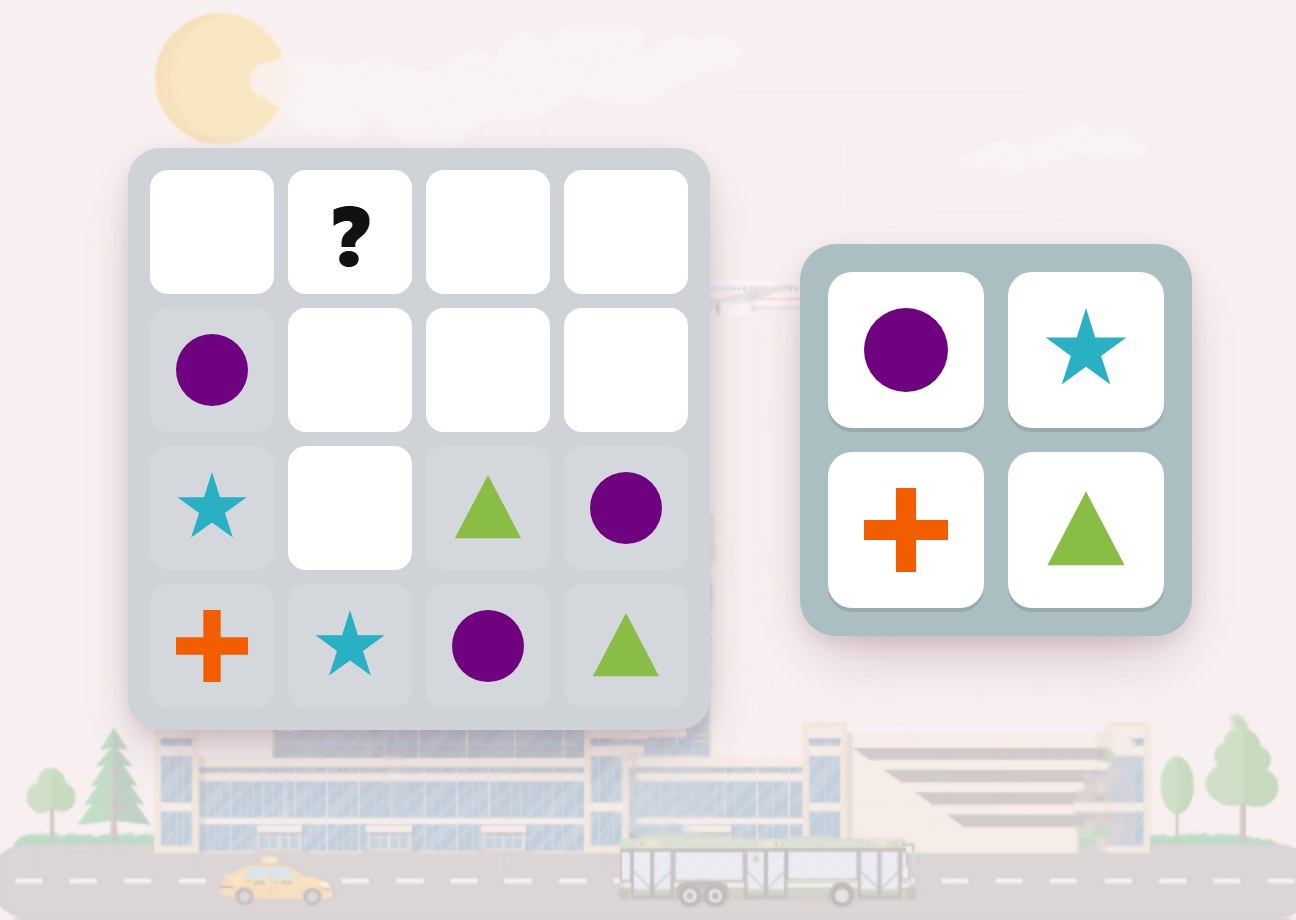
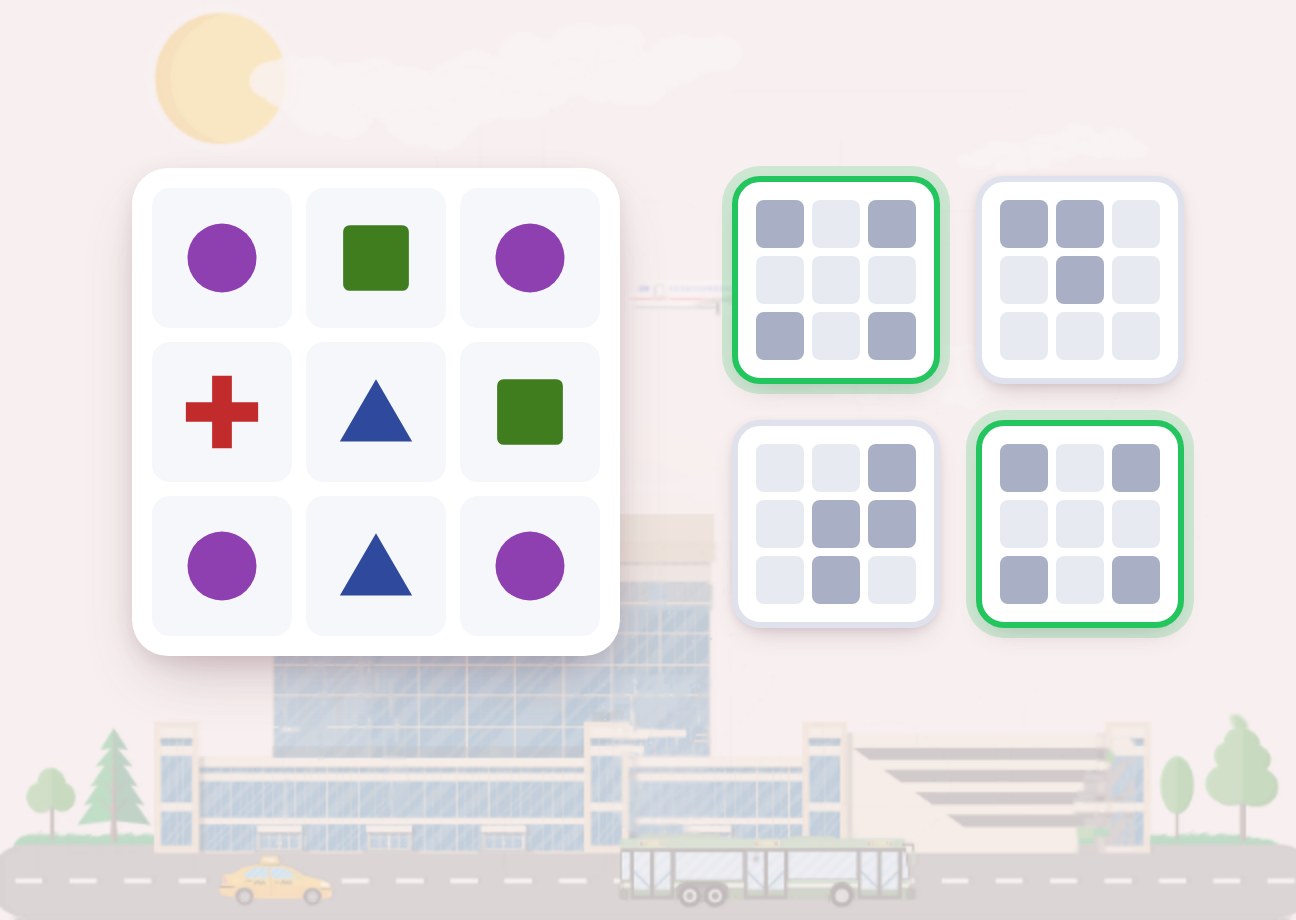
They are separate tests and CADETPRO ships a module for each. In the two inductive tests you work out a hidden rule and then apply it — classifying patterns, or picking the candidates that obey it. Here you never have to state the rule at all; you point at the object that breaks it. The stimulus is different too: one row of nine objects rather than a grid of shapes, ten questions in ten minutes rather than twelve or fifteen, and free navigation with flagging.
Is the demo on this page the real module?
Yes. The player and the walkthrough panels load the same module you get after purchase, straight from hub.cadetpro.com. The free EASY and MEDIUM modes are open without buying anything; EASY explains the rule after every question, which is the fastest way to learn the families.
What is the difference between the four modes?
EASY gives you 6 questions with no time limit and an explanation after each one — the correct answer plus the rule in words. MEDIUM moves to 10 questions, still untimed, with the review at the end instead. HARD is 10 questions in 10:00 with the review at the end. EXAM is the same 10 questions in 10:00 with no feedback at all — real conditions.
Is there a penalty for a wrong answer?
No. A wrong answer and an unanswered question score exactly the same, which means leaving a box empty can only cost you. With nine options a guess is worth about an eleven per cent chance and a blank is worth nothing, so the last thirty seconds of a timed run are best spent filling in anything still empty.
How is the score worked out?
The result screen shows the raw number correct and a performance percentage. The percentage is the platform-wide formula and it is not linear: one and two correct out of ten score the same, while going from four correct to five is worth thirteen points and eight to nine is worth twelve. In practice that means a careless loss on an easy question costs exactly as much as failing to crack a hard one.
What do I get after purchase and for how long?
PRO access opens the HARD and EXAM modes and the advanced sections of the performance report — the family-by-family matrix, your flagging behaviour and whether your answers drift toward a favourite letter. Access runs for the period you choose — 30, 90 or 365 days — and renews automatically for the same period unless you cancel.
Is this an official Wizz Air product?
No. CADETPRO is an independent preparation platform and has no affiliation with, endorsement from or partnership with Wizz Air or any assessment provider. The module reproduces the publicly described format of the test so you can practise it; it is not the assessment itself, and no result here guarantees any outcome in a real selection process.